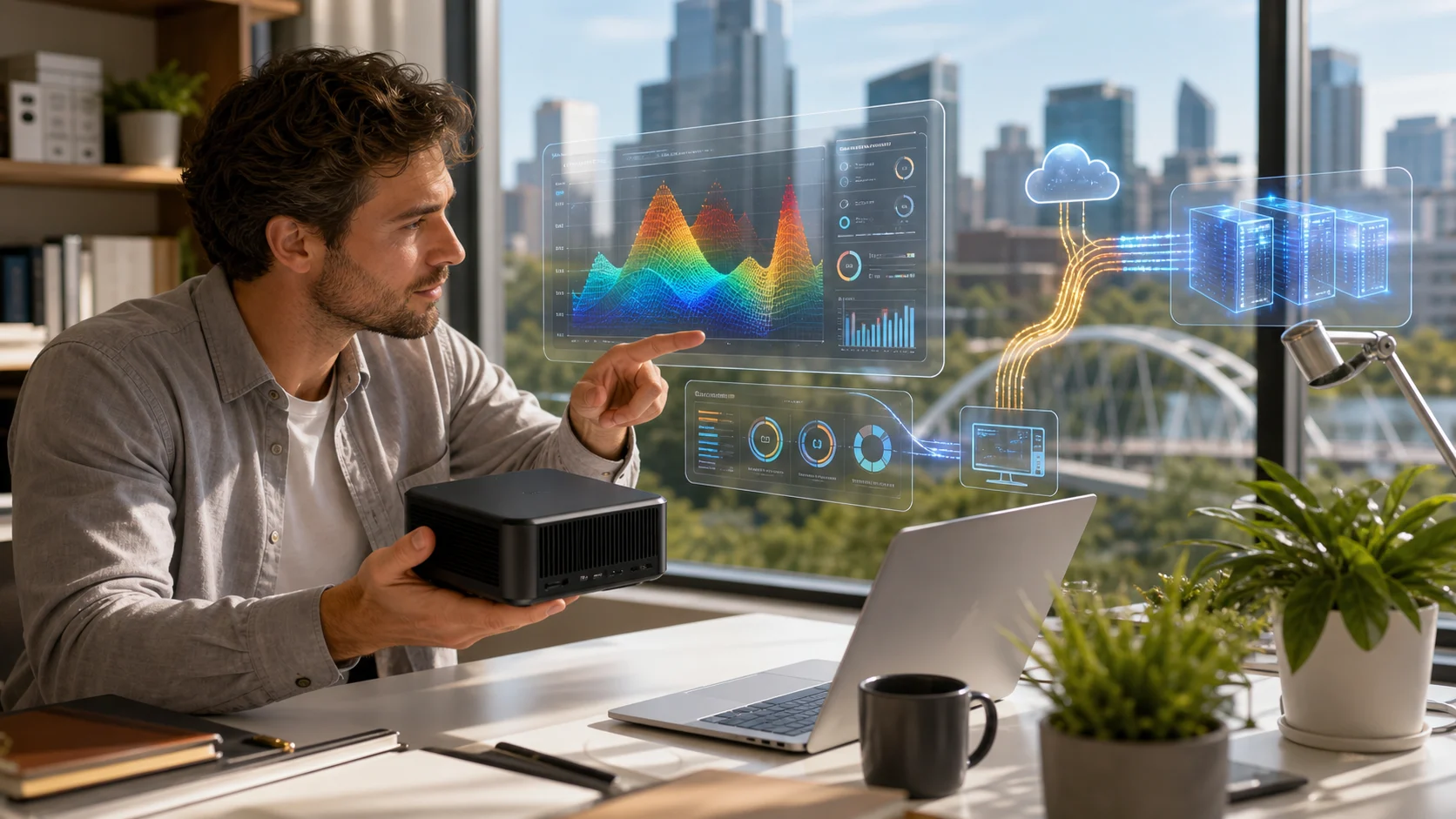
A compact workstation that can run serious models locally is exciting because it changes the privacy conversation. But viral posts often flatten the important details: configuration, shared memory, model quantization, sustained performance, and what the business actually needs to run.
What is actually interesting
AMD's Ryzen AI Max family points toward a practical middle ground between rented cloud GPUs and expensive desktop GPU towers. Unified memory can make larger local models easier to test, especially for private research, document analysis, coding help, and offline demonstrations.
The footnotes buyers should verify
Before buying, confirm the exact chip, RAM configuration, usable GPU memory, operating system support, model runtime, thermal behaviour, vendor warranty, and the benchmark that matches your workload. A DeepSeek benchmark, a coding model, and a document retrieval system are not the same purchase decision.
The Opcelerate take
For Alberta businesses, local AI is strongest when privacy, latency, data residency, or predictable cost matters. It is weaker when the work needs always-current frontier reasoning, heavy multimodal throughput, or managed enterprise compliance.
Use it for the right work
Good early workloads include private document search, internal policy Q&A, local coding assistants, field-report drafting, offline demos, and staff training labs. Do not treat a compact workstation as a magic replacement for all cloud AI. Treat it as a controlled private lane.